Fitzpatrick Skin Types Explained: Why Your Skin Type Matters for Laser & Aesthetic Treatments
Not all skin responds the same way to laser and light-based treatments. One of the most important factors in determining treatment safety, settings, and results is your Fitzpatrick skin type.
At Denver Dream Med Spa, we use the Fitzpatrick scale as a foundational tool when customizing laser hair removal, IPL photofacials, and other advanced treatments. This guide explains what Fitzpatrick skin types are, how they affect treatment decisions, and why proper classification is critical — especially in Denver’s high-altitude environment.

What Is the Fitzpatrick Skin Type Scale?
The Fitzpatrick Skin Type Scale is a classification system used in dermatology and aesthetics to describe how skin reacts to sun exposure.
It categorizes skin into six types (I–VI) based on:
Natural skin tone
Tendency to burn or tan
Melanin content
Sensitivity to UV and laser energy
This system helps providers determine:
Appropriate laser wavelengths
Safe energy settings
Risk for pigmentation changes
Ideal treatment plans
Why Fitzpatrick Skin Type Matters for Laser Treatments
Laser and light-based treatments work by interacting with melanin (pigment) in the skin and hair.
Correctly identifying skin type allows providers to:
Maximize effectiveness
Minimize irritation or burns
Prevent hyperpigmentation or hypopigmentation
Customize treatment safely
Using incorrect settings for a given skin type can compromise results or increase risk — which is why experience and education matter.
The Six Fitzpatrick Skin Types Explained
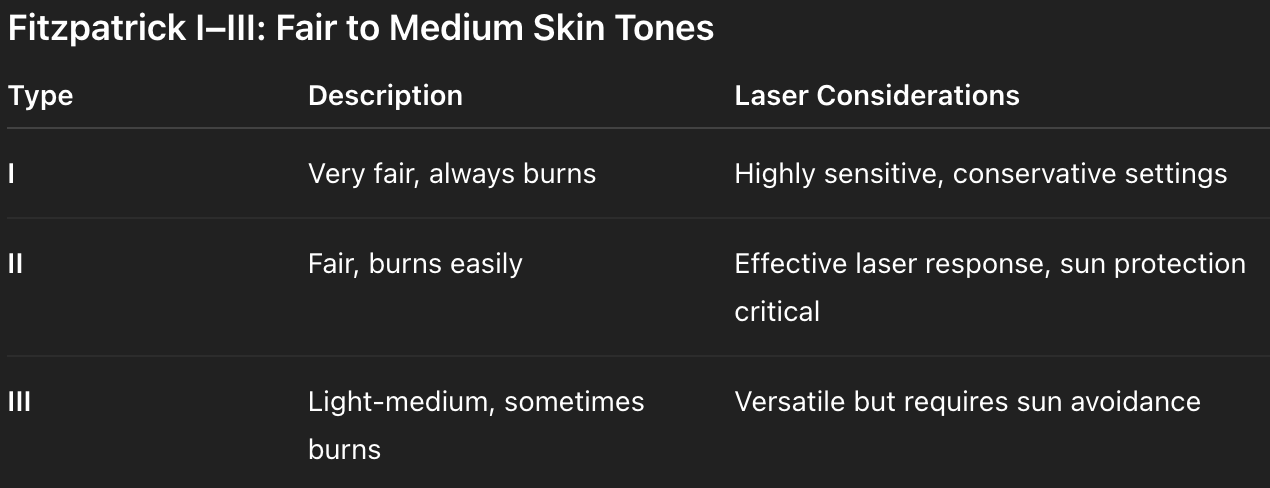
Fitzpatrick Type I
Very fair skin
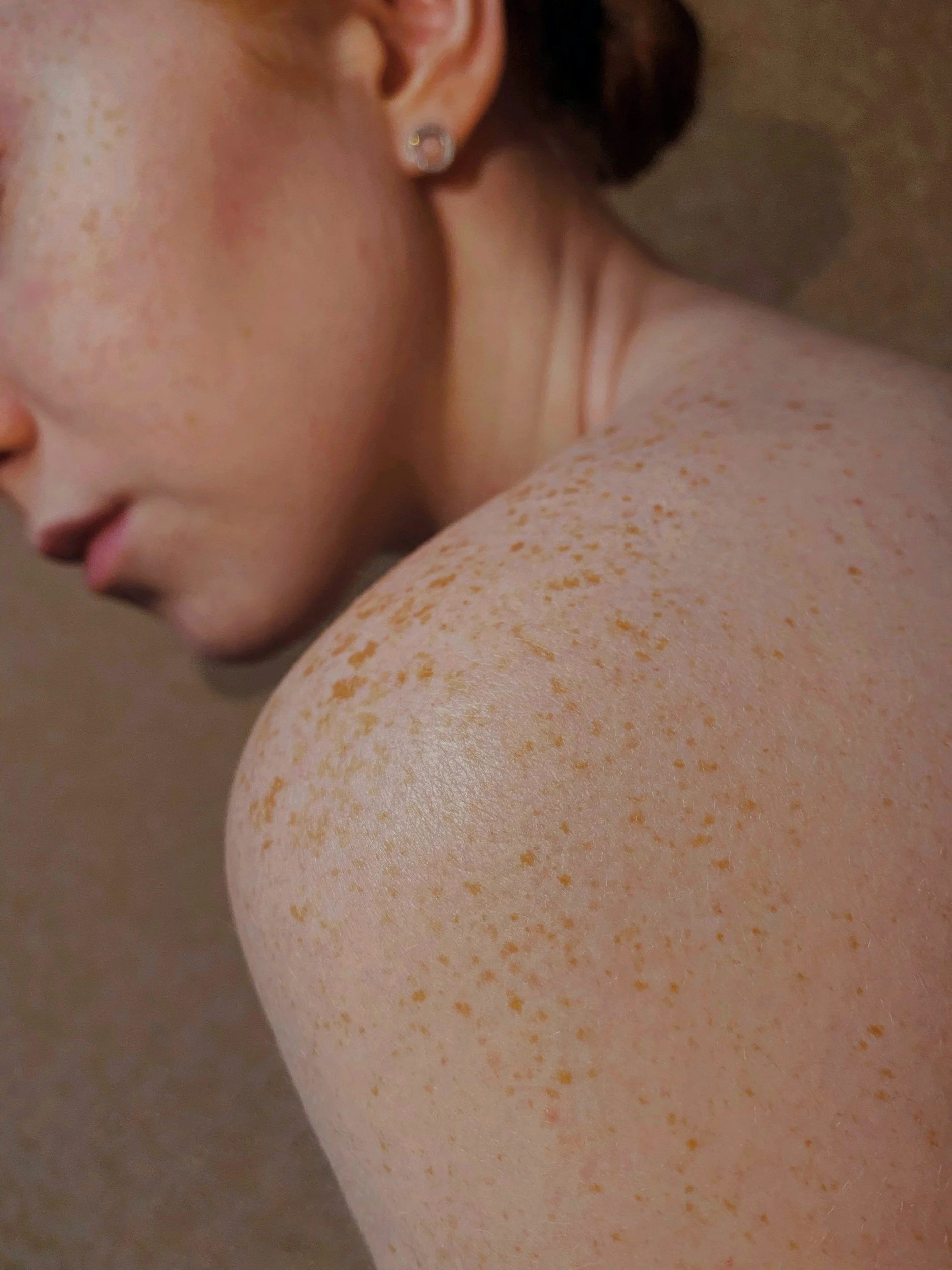
Always burns, never tans
Often red or blond hair
Freckles common
Treatment considerations:
Highly sensitive to UV and laser energy. Conservative settings are essential.
Fitzpatrick Type II
Fair skin
Burns easily, tans minimally
Light eyes and hair common
Treatment considerations:
Low melanin allows effective laser treatment, but sun protection is critical.
Fitzpatrick Type III
Light to medium skin
May burn initially, tans gradually
Very common skin type in Colorado
Treatment considerations:
Versatile skin type but still requires sun avoidance before and after treatments.
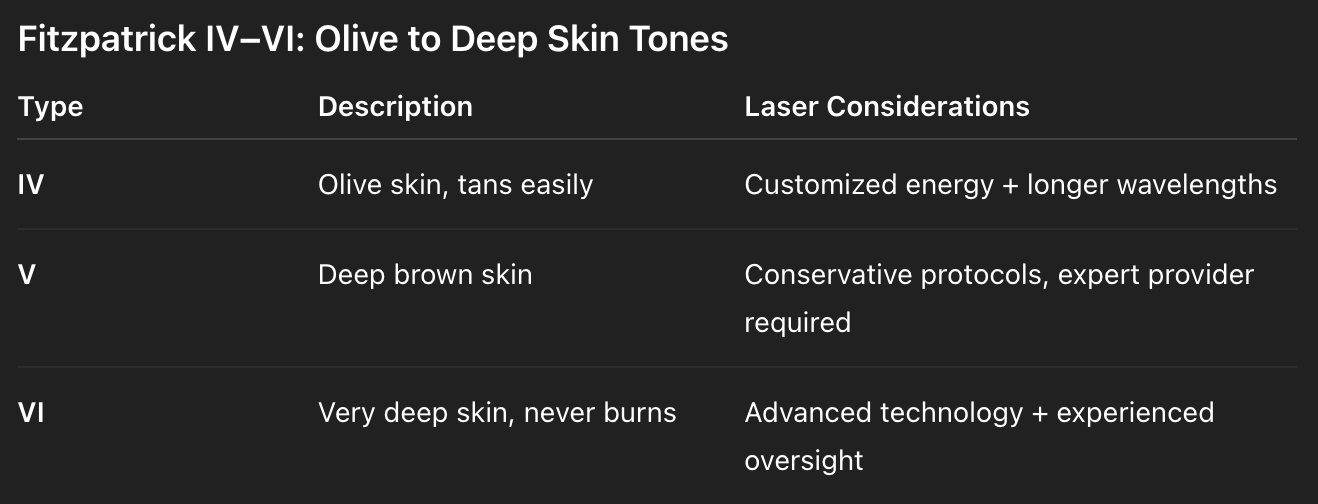
Fitzpatrick Type IV
Medium to olive skin
Rarely burns, tans easily
Increased melanin content
Treatment considerations:
Requires customized laser settings and cautious progression to avoid pigmentation changes.
Fitzpatrick Type V
Deep brown skin
Very rarely burns
High melanin levels
Treatment considerations:
Best treated with longer laser wavelengths and conservative protocols.
Fitzpatrick Type VI
Very deep skin
Never burns
Highest melanin content
Treatment considerations:
Advanced laser technology and expert provider oversight are essential for safety.
Fitzpatrick Skin Type & Laser Hair Removal
Laser hair removal can be effective across all Fitzpatrick skin types when the correct technology and settings are used.
Key considerations:
Darker skin types require longer wavelengths
Lighter skin types may tolerate higher energy
Hair color, thickness, and growth cycle also matter
This is why no two treatment plans should be identical.
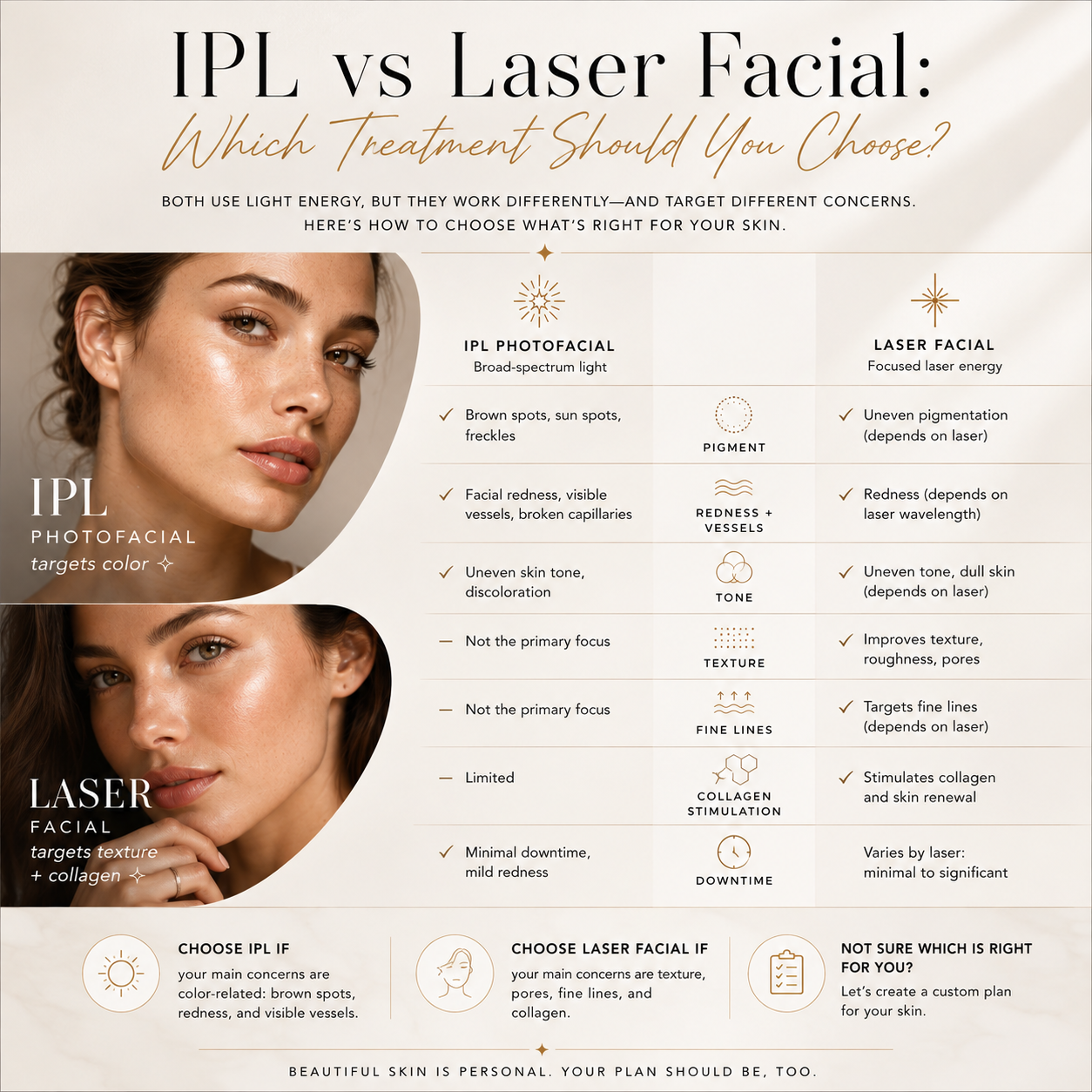
Fitzpatrick Skin Type & IPL Photofacials
IPL treatments rely on light absorption by pigment, making skin type especially important.
Fitzpatrick I–III: Often ideal candidates
Fitzpatrick IV: May be candidates with caution
Fitzpatrick V–VI: Often not ideal for IPL; alternative treatments may be recommended
A professional consultation determines candidacy safely.
Fitzpatrick Skin Type & Denver’s Climate
Denver’s high altitude increases UV exposure, which affects all skin types — even those that tan easily.
Important considerations:
Sun exposure can temporarily change skin behavior
Recent tanning alters laser safety
SPF use is essential for every skin type
At Denver Dream Med Spa, we factor seasonal sun exposure into treatment planning.
Can Your Fitzpatrick Type Change?
Your baseline Fitzpatrick type does not change, but your current skin condition can.
Temporary changes include:
Recent tanning
Sunburn
Self-tanner use
Skin irritation or inflammation
These factors may require postponing or adjusting treatments.
How We Determine Fitzpatrick Skin Type at Denver Dream Med Spa
Your Fitzpatrick type is determined through:
Detailed consultation
Skin tone assessment
Sun reaction history
Visual evaluation by trained providers
We never rely on assumptions — accuracy protects your skin.
Why Provider Experience Matters More Than Skin Type Alone
While Fitzpatrick classification is essential, it’s only one part of safe treatment.
Experienced providers also consider:
Hair characteristics
Skin sensitivity
Treatment area
Medical history
Long-term skin goals
This layered approach ensures safe, effective, and ethical care.
Fitzpatrick Skin Type FAQs
Can people with dark skin get laser treatments?
Yes, with the right technology and experienced providers.
Does Fitzpatrick type affect results?
It affects settings and approach — not your ability to get results.
Why is IPL sometimes not recommended for darker skin?
IPL uses broad-spectrum light, which increases pigmentation risk in deeper skin tones.
Is Fitzpatrick type the same as ethnicity?
No. Fitzpatrick classification is based on skin response, not race or ethnicity.
Education Protects Your Skin & Results
Understanding your Fitzpatrick skin type helps you make informed decisions and ensures your provider selects the safest, most effective treatment approach.
At Denver Dream Med Spa, education is part of the treatment — because informed clients get better results.
👉 Schedule Your Personalized Laser Consultation in Denver
We’ll assess your skin type, goals, and lifestyle to create a plan designed for you.

✨ Refresh your look without surgery.
Learn More: